Visual: not a studio.
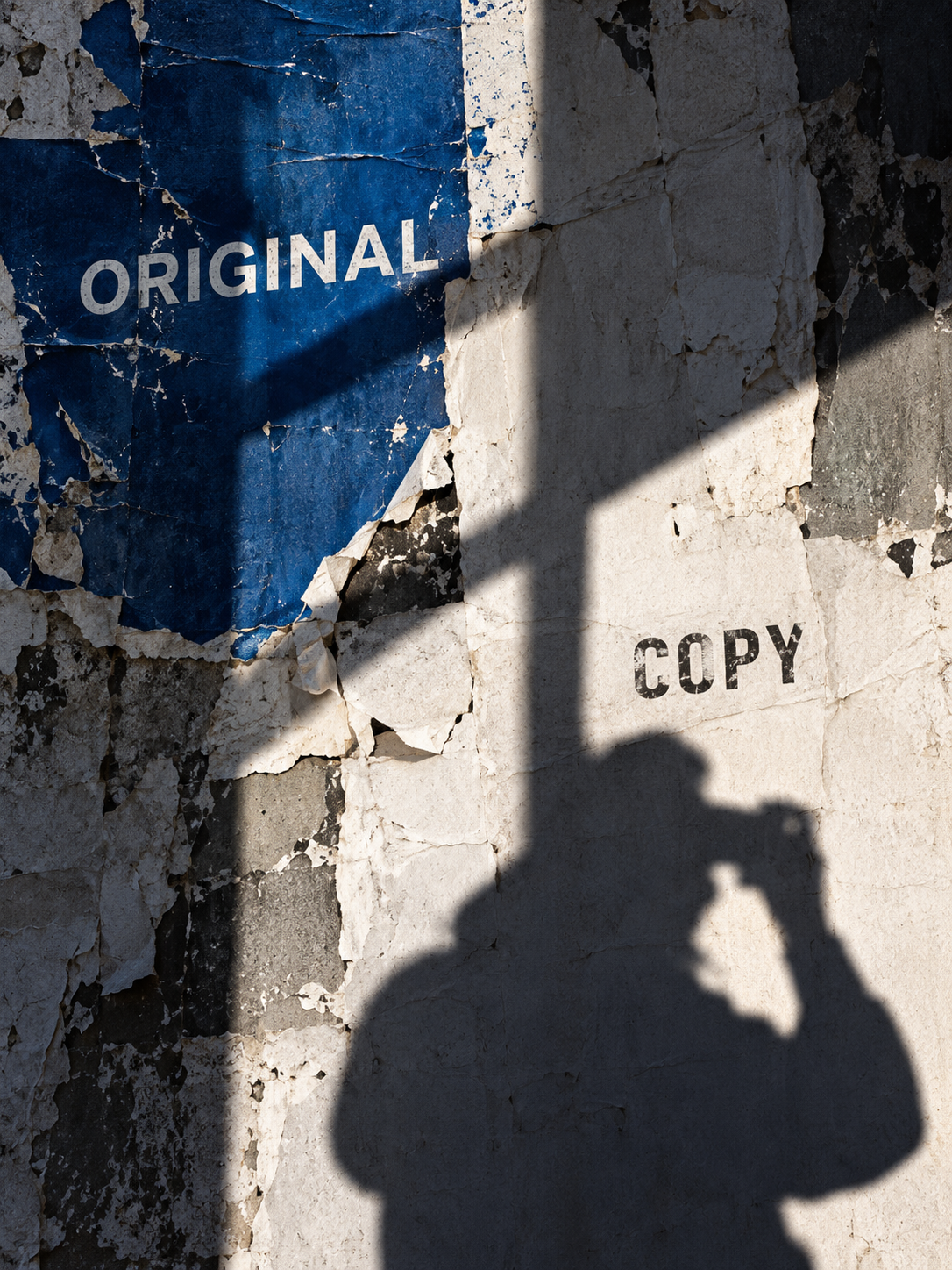
A few months ago, Stefan found a formula on Instagram that started to work. His carousels travelled further, the community grew, and certain colours, layouts, rhythms of writing and visual cues began recurring consistently enough for people to recognise them before checking whose name was above the post. Then the copies started appearing.
They were not necessarily copies in the easiest sense of the word. There was no identical sentence, no single colour, no isolated element you could circle in red and confidently claim as his. What started appearing elsewhere was closer to an entire system. The same rhythm, the same logic, a similar way of talking about work and presenting yourself, sometimes close enough to make coincidence feel like a generous explanation.
Once, he reacted publicly. Let’s just say revenge was not particularly cold.
That was when the more interesting question emerged. Recognising somebody else’s photograph is easy enough when it has simply been downloaded and reposted. Things become considerably less clear when what has been taken is a rhythm, a method, a combination of choices, a recognisable system, or an idea that has already started functioning as somebody’s language
How similar is too similar?
We opened the question of authorship with two women who approach it from very different positions. Jovana Rakezić, an architecture and interiors photographer, has spent years coming across companies using her photographs, only for an almost invisible culprit to appear somewhere behind the post: someone at the company, or someone else who supposedly handles their social media. Marijana Zejaković, a lawyer and partner at TSG Attorneys, enters the conversation at the point where creative intuition stops being enough. She describes the role rather more entertainingly herself. The moment a client proudly jumps up and says, that’s mine, the lawyers arrive, known as the people who spoil the game, to check whether that is actually true.
One speaks from the reality of making the work, the other from the law. Somewhere between the two sits almost the entire creative industry.
Visual: not a studio.
PUBLISHED DOESN’T MEAN GIVEN AWAY
Jovana has worked professionally as a photographer for more than thirteen years, long enough to watch the role of the image change completely. Social media once functioned as a place for holidays, daily life and things we wanted to show our friends. Today, it forms part of the sales infrastructure. A photograph of a hotel sells a night’s stay. A photograph of a restaurant sells dinner. An interior photograph sells a project, a chair, a lamp or, increasingly, an entire idea of how life might look.
“At some point, it simply stopped making sense to me that everyone benefiting from a photograph could recognise its value except the person who created it.”
The logic is difficult to argue with. If somebody uses an image because they expect it to generate attention, credibility or sales, they have already acknowledged that the image carries value.
Like many of us, Jovana grew up in a culture where piracy was treated as more or less normal. She thought of the internet as a bottomless hat full of free things. Her perspective changed while working in the communications team of a foreign government and later with international architecture practices, where licensing photography was treated as an ordinary part of professional life.
“That was a kind of trigger for me to stop and, instead of falling back on our usual oh, what does it matter, actually learn why those rules exist.”
Marijana leaves considerably less room for romance. Does the fact that something has been publicly posted on Instagram, Pinterest or a website change anything when it comes to permission for further use?
“No.”
Then she gets more precise.
“Respecting an author’s moral rights by including a photo credit or naming the author on social media does not mean that you are entitled to use the work. Crediting the author when reproducing a copyrighted work is neither permission nor a substitute for permission to use it.”
Jovana reduces the same principle to one sentence from everyday practice.
“The internet may be where you found it, but the internet is not its author.”
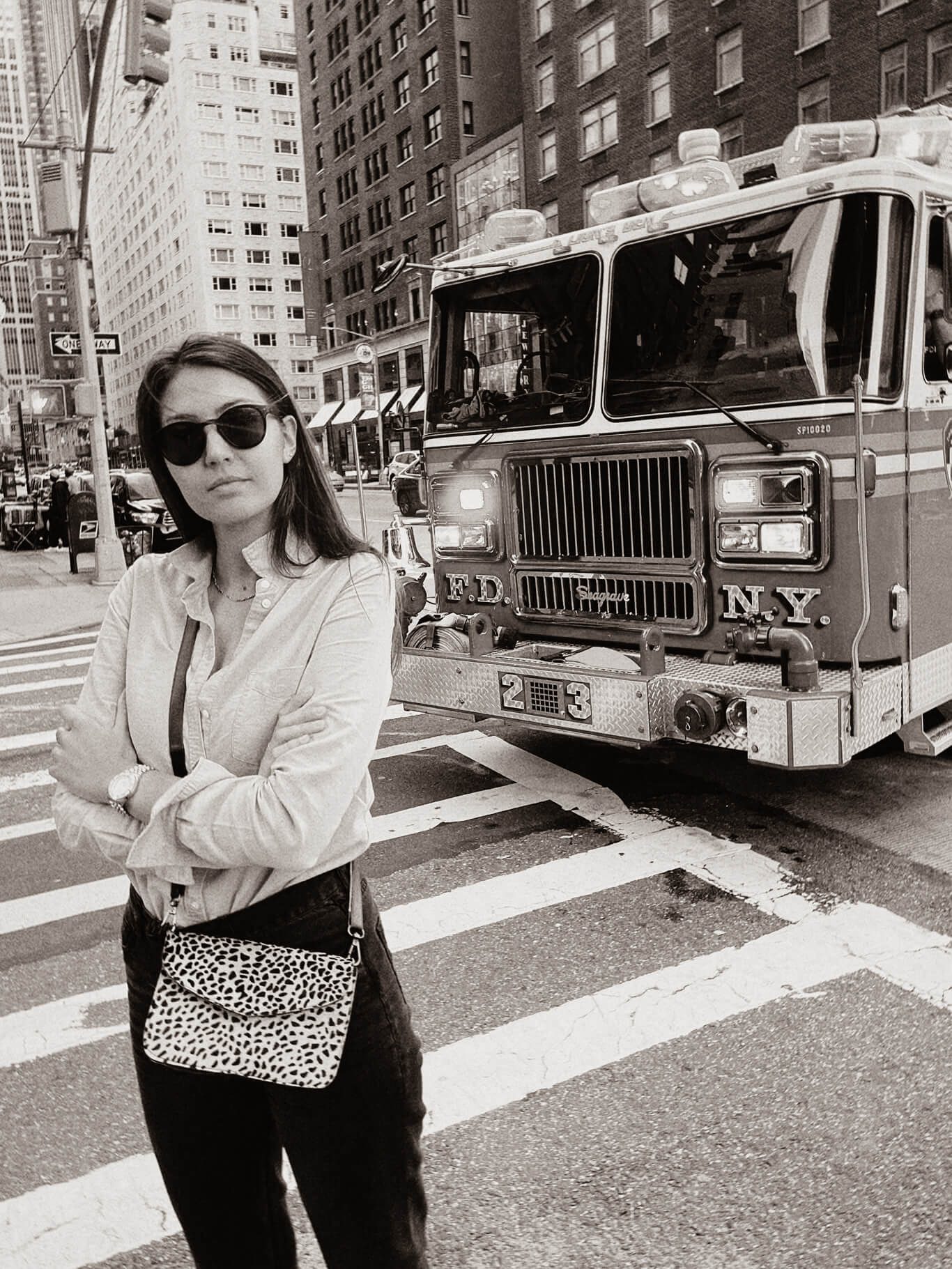
Jovana Rakezić
MY SOFA, YOUR PHOTOGRAPH
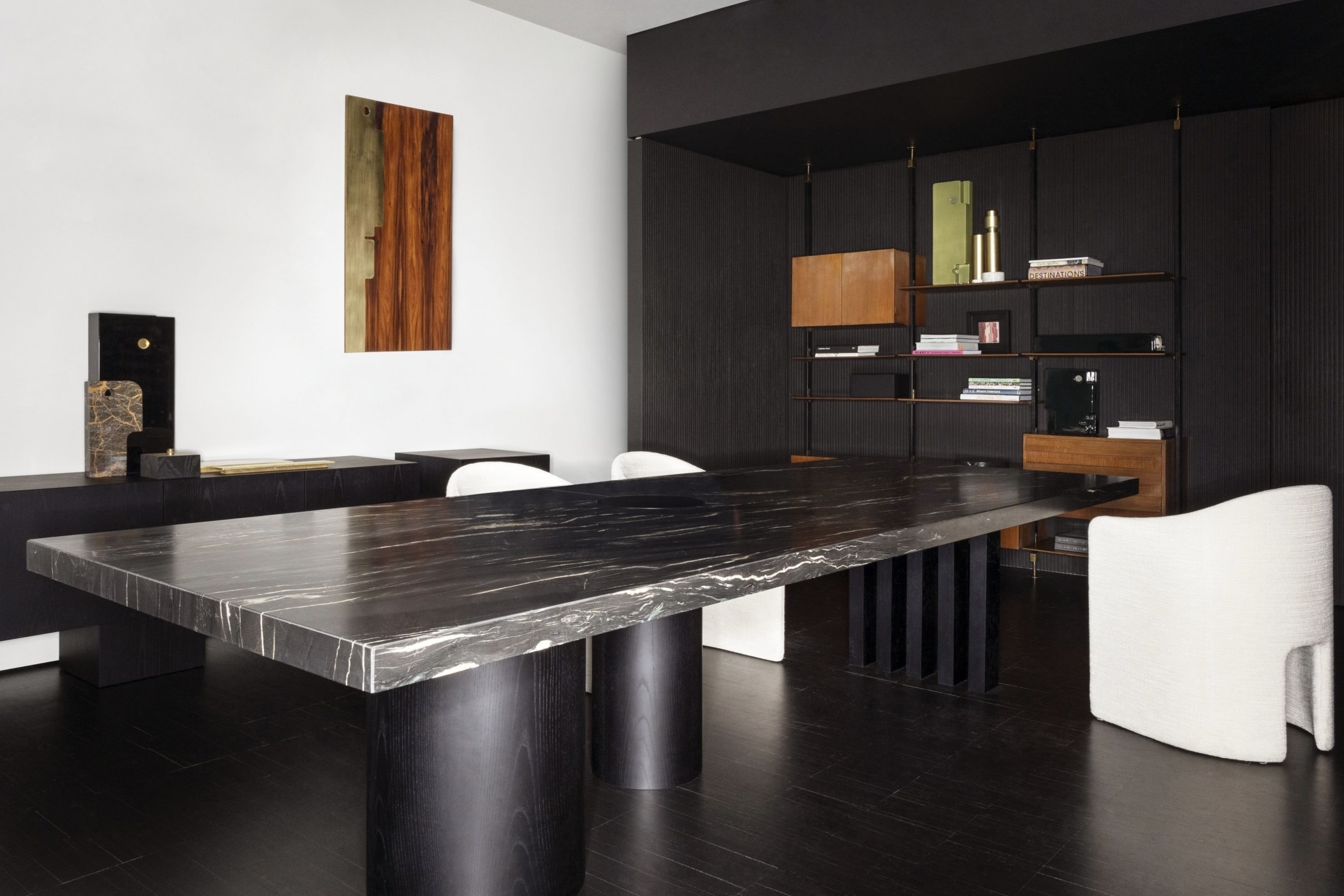
Architecture and interiors are almost perfectly designed to produce confusion. One photograph may contain the work of an architect, an interior designer, an investor, a sofa manufacturer, a lighting designer, an artist, a piece of bespoke furniture and several other companies involved in making the frame look exactly the way it does.
They are all in the photograph. The photograph still does not belong to all of them.
Jovana has a favourite classic.
“But that’s my sofa/building/lamp in the photograph! Insert whatever you like.”
Photographing a chair does not make the photographer the designer of the chair.
“A single photograph can contain the work and authorship of many different people at the same time, while each of them remains the author of their own work.”
Marijana complicates the story exactly as much as necessary. As a rule, an architect holds copyright in the architectural design and the architectural work. An investor does not automatically acquire those rights simply by commissioning and paying the architect. The photographer remains the author of the photograph, while the scope of rights held by everyone else depends on the agreements in place.
The same applies to a brand whose product happens to appear in the image. Its sofa may be in the photograph. That does not automatically give the company the right to use the photograph in its own marketing.
“It all depends on the contract.”
One of the most persistent misunderstandings Jovana encounters starts with a familiar sentence: I paid for the shoot, so the photographs are mine.
The client did pay for the shoot. The rights that payment actually secured are another matter. Under the model Jovana most commonly works with, the commissioning client may use the photographs to promote their own work, but cannot automatically pass them on to third parties for those parties’ commercial use. A broader scope of rights or exclusivity can be agreed separately and priced accordingly.
“Almost anything can be agreed. What matters is that both sides know from the beginning exactly what they have agreed to.”
Marijana condenses the same problem into a very good business sentence.
“A good contract eliminates room for assumptions.”
Assumption is often the most expensive thing in a creative business.
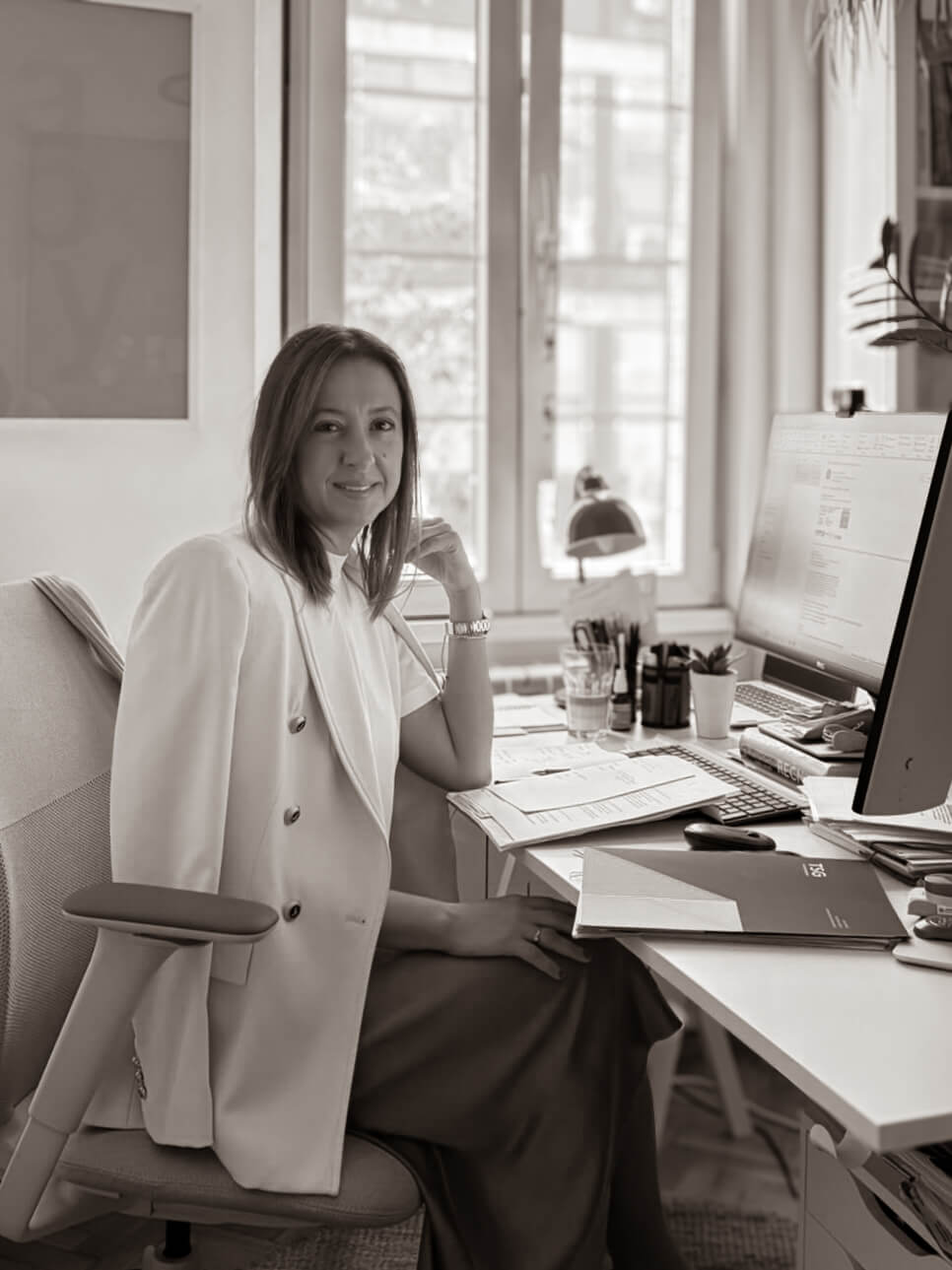
Marijana Zejaković
WHEN SOMEONE ELSE’S WORK STARTS SPEAKING YOUR LANGUAGE
This is where the conversation becomes more difficult. A photograph is at least a clearly identifiable work. There is a file, there is an author, and there is usually a recognisable moment when someone else takes that file and uses it.
What, then, do we do with the thing that made Stefan furious?
He did not invent the Instagram carousel. He did not invent a particular colour. He did not invent graphic rhythm, nor the idea that an architect could speak directly to an audience. All of those things already existed. What he did build was a particular combination of those elements that gradually became a recognisable system and then started generating an audience, visibility and business value.
So, what, within that formula, was actually his?
That was exactly the problem. There was no single element he could isolate and say, this belongs to me. He was not reacting to one colour, one frame or the simple fact that somebody else had started using carousels too. He was reacting to the accumulation of similarities. The way the elements began to sit together. The rhythm, the tone, the visual discipline and the way professional work was being turned into content.
Each part on its own could belong to everyone. Together, they had started to resemble a language he had been building for some time.
That was where the frustration came from. If you have built something for long enough that an audience begins to recognise it as yours, does the fact that you did not invent any of its individual ingredients mean that anyone is free to take the recipe? How many ingredients have to reappear before inspiration starts looking like imitation?
When asked where inspiration ends and infringement begins, Marijana laughs first.
“You’ve given me a difficult one. Can I swap the question?”
Her mind goes first to her favourite architect, Zaha Hadid, specifically Wangjing SOHO in Beijing and the Meiquan 22nd Century complex in Chongqing, which she feels bears a striking resemblance to it.
It is a useful example because the eye reaches its conclusion almost immediately. The law has to do something far more difficult.
“Copyright does not protect ideas. It protects the way those ideas are expressed.”
Nobody owns the idea of an interior combining mid-century modern design, wood and plastic. A specific design solution that emerges from those ingredients may, however, qualify for protection if it constitutes an original expression.
Marijana draws the boundary more precisely.
“Copyright protection does not extend to general ideas, procedures, methods of operation, principles or instructions contained within a copyrighted work.”
The line between inspiration and infringement rarely arrives neatly marked. If a dispute were to arise, the question would be whether a sufficiently original and recognisable part of somebody else’s work had been taken, and whether an average observer could identify an unauthorised or excessive appropriation of a specific creative solution in the new work.
This is where Stefan’s case becomes more interesting than the simple question of whether somebody stole something.
Recognisability alone is not the same thing as legal protection. A strong feeling that you are looking at your own language inside somebody else’s work does not, by itself, prove infringement. Between those two positions is a space that the law cannot always close neatly, even if a creative community can sense its existence almost immediately.
Something can be obviously derivative, dull or uncomfortably close to somebody else’s work while the legal question remains far more complicated. The law does not resolve every problem of taste. It does not resolve every bruised ego either, and that is probably a good thing.
The fact that something would be difficult to sue over does not automatically make it something worth being particularly proud of.
This is where law and culture part ways. One establishes the minimum boundary of what is permitted. The other decides what kind of creative culture we want to have.
Stefan chose an Instagram Story. It may not have been the coldest form of revenge, but it did at least open up a good question.
Visual: not a studio.
A PHOTO CREDIT DOESN’T PAY THE BILLS
We didn’t know is probably the explanation Jovana hears most often when she contacts someone about the unauthorised use of one of her photographs.
“That’s usually when you can tell very quickly whether they genuinely didn’t know or simply didn’t expect me to see it.”
Sometimes the situation ends perfectly normally. The company corrects the mistake, someone licenses the photographs retrospectively, and in some cases Jovana later goes on to work with them. When an agreement has not been honoured or the use has not subsequently been paid for, there have also been formal notices and legal proceedings. Protecting authorship is part of doing business.
Jovana brings the issue back to its most concrete consequence: money.
“If a company takes, say, thirty photographs without permission that it would otherwise have had to license, the photographer has not lost something abstract. They have lost actual income.”
The digital world merely makes that loss less visible. Nobody smashed a shop window and ran away carrying thirty photographs under their arm. Someone simply started using them to generate their own economic benefit.
“The fact that something is digital and easy to download does not mean that it has no owner or no value.”
For Jovana, the question of authorship therefore reaches much further than permission. It says something about the way we value creative work in the first place.
“The creative industries may be a relatively young sector of the economy, but globally they are now an enormous economic force. Here, however, we still grow up hearing the same sentence: You can’t make a living from that.”
That one sentence contains an entire chain of problems. People struggle to put a price on their work. They feel uncomfortable setting rules, then equally uncomfortable saying when somebody has broken them.
“And every time we stay silent, we unintentionally reinforce the idea that perhaps our work really isn’t something that should be paid for and protected.”
Marijana approaches the same problem through ownership of rights. An author acquires copyright simply by creating the work. No registration or other formality is required. The author, the person or company financing the work, and the person entitled to use it, however, are not necessarily the same party.
“Only once we establish who the author is and what agreements they have entered into can we begin to answer the question of what is actually ‘mine’.”
So that’s mine is sometimes entirely correct. Sometimes it is only the beginning of the conversation.
Marijana returns to the contract as the place where many of these misunderstandings should disappear. A good agreement clearly defines the work, the rights being transferred or licensed, the fee and the scope of use. Phrases such as all rights included mean very little if nobody has established which rights, for what purpose and to what extent.
Jovana eventually brings the entire subject back from legal language into everyday life.
“The bare minimum is to ask.”
If you like somebody’s photograph, illustration, text, music or any other work enough to want to use it, find the person who made it and ask.
“Maybe they’ll say yes, free of charge, as long as you credit them. Maybe they’ll ask for a fee. Maybe they won’t want you to use it. Maybe they’ll give you twice as much as you asked for. But that is their yes to give. It isn’t ours to assume on their behalf.”
The internet has removed almost every physical obstacle between wanting something and taking it. Right-click, screenshot, download. A few seconds are enough. What disappears in that frictionless movement is the person on the other side of the image, the text or the piece of music. Someone spent years learning, buying equipment, developing an eye, making mistakes and building a career, and probably expects that career to pay the rent, the taxes, a holiday or a coffee for a friend.
At the end of our conversation around the table, Marijana adds one final piece of advice.
“Nurture and express your creativity. We need it more than ever in an age of artificial intelligence and recycled ideas.”
A creative industry starts behaving like a serious industry when it takes seriously the very thing it lives from.
Long before copyright law, formal notices or a courtroom, there is a much simpler thought:
This isn’t mine. Let me ask the person it belongs to.
Visual: not a studio.