Nicolas Blažičević © cedou.cedou
There is a Belgrade people have been declaring dead for years. The old one, obviously. The one with better bars, stranger characters, less money and supposedly much better taste.
I never entirely bought it, because I keep finding pieces of it elsewhere. Whenever I travel, I look for Dorćol without actually looking for Dorćol. Not the cobblestones, the architecture or another carefully distressed café, but a certain urban instinct: good clothes without much effort, a little disorder, rooms that have already lived several lives and people who know things without constantly announcing that they know them. I found it once in Istanbul. This time, in Nice. Not on the Promenade des Anglais, but in Nicolas Blažičević.
His Jour de pluie à Belgrade could be a still from a film about the city nobody ever got around to making. A red kiosk roof, a POP CORN sign, old Coca-Cola lettering, graffiti, wet asphalt, the kind of minor urban architecture we pass every day until we stop seeing it. The work belongs to a series of Belgrade scenes painted on cardboard, some of which he plans to turn into prints.
Nicolas was born and raised in Nice, but his connection to Belgrade predates him. His father was born and raised here before moving to Nice as a young man. So his Belgrade is not quite an outsider’s view of the city, nor an attempt to return to something that was once his. He notices surfaces already marked by other hands, objects from the street, temporary structures, things ordinary enough to escape attention until someone looks at them long enough to make them worth painting.
Sometimes I think Nicolas is the version of me who, in another life, picked up a brush instead of a keyboard. What draws me in is his relationship with work, that street instinct disciplined enough to master a craft and loose enough never to turn it into a uniform. His practice already says something about that: stencils, classical imagery, pop references, paintings on cardboard, dozens of square metres of hand-painted canvas that eventually become part of an interior. He does not seem particularly interested in the borders between those worlds, as long as he knows why he is crossing them.
Old Belgrade used to produce people like that: people who could mix high and low, serious work and a good joke, taste and a small dose of bad behaviour, without needing a manifesto to explain themselves. They say that Belgrade is gone. I keep finding it, this time in Nice.
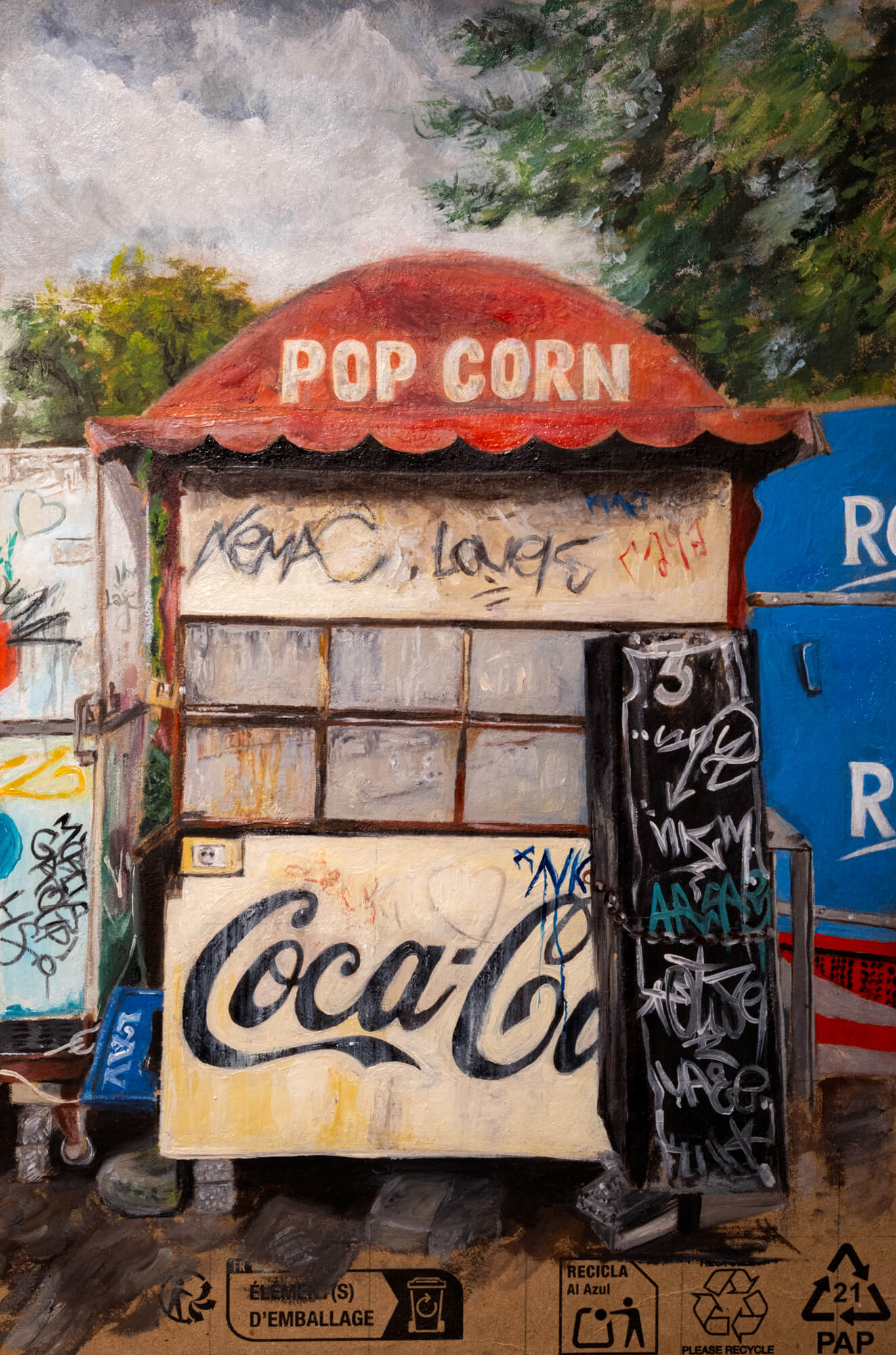
Belgrade un jour de pluie
LEAVE YOUR EGO OUTSIDE THE STUDIO
The art world still likes the idea of the autonomous artist, alone in a studio, far enough from clients, budgets and other people’s requests for a personal vision to remain untouched. The word commission has carried the smell of compromise for long enough that money entering the room can still make everyone slightly uneasy. Nicolas sees it differently.
“For me, commissions are what make my work rich. Every project pushes me towards techniques, materials or worlds I wouldn’t necessarily have chosen on my own, and that’s how I’ve ended up being able to do almost anything technically. It means I can bring ideas to the table and never feel stuck when faced with a request.”
There is a less romantic part of the equation too. A commission meets two needs: the chance to make something with his own hands and, on top of that, to be paid for it.
“I think it’s wise to keep ego out of the process.”
That does not mean it makes no difference who brings the idea. The question becomes more complicated when the client is not simply commissioning his hands. What, in the end, are you buying when you commission an artist?
“Probably all of it. When I work with architects, for example, it’s mostly my ability to bring their ideas to life. When people come for my own world, it’s something else: my taste, a memory, a message, deliberate or not, taking shape in colour.”
The boundary between collaboration and service exists. He just does not find it particularly troubling.
“Yes, definitely, and it’s not a bad thing. It’s precisely through my collaborations that I get to show my expertise. But honestly, I never really ask myself that question.”
Art history makes our contemporary anxiety around commissions look slightly strange anyway. Renaissance masters worked for churches, courts, merchants and powerful families, while Nicolas locates one of the important shifts much later, with the Impressionists.
“They were among the first to move away from expectations, to paint what they wanted rather than what they were asked to, and to build their own audience. Times change, and that’s a good thing. Today an artist can choose not to answer a specific request and build their own audience instead.”
He has no interest in choosing between the two positions.
“For me, the two aren’t opposed. Commissions and free creation feed into each other.”
Nor does he assign some magical creative value to constraint. When I ask whether he has ever made a better work precisely because he did not have complete freedom, he says probably not, or at least he is not sure. The result may be better for the person receiving it or for the viewer. That does not necessarily make it better for him. For himself, the answer is easy.
“Go for it, you’ve got carte blanche!”
That says more about his relationship with work than any theory could. A commission is not the enemy of freedom, and freedom is not proof of artistic purity. One expands his repertoire. The other gives him room to see what he can do with it.
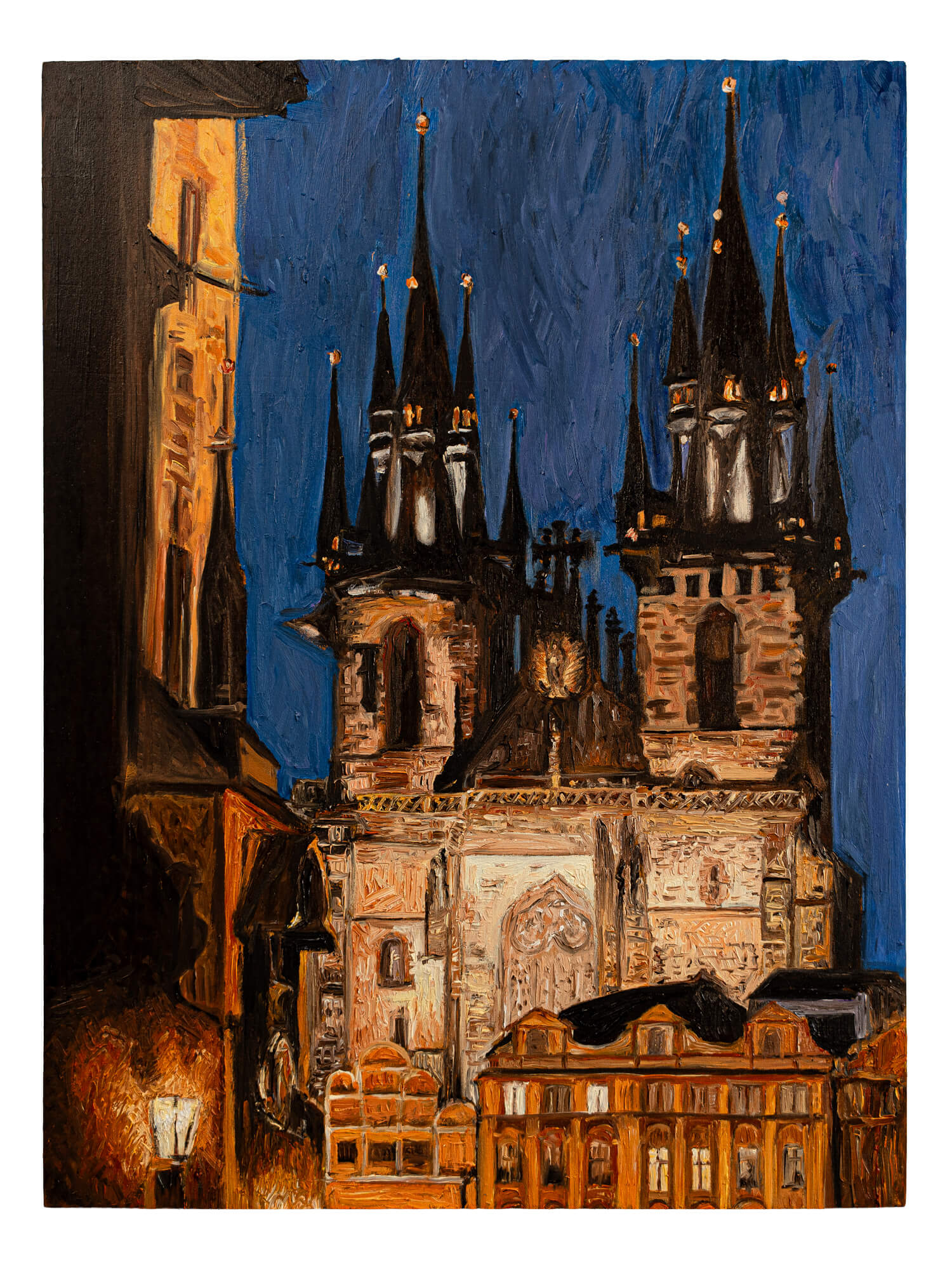
Our Lady before Tyr
WHEN ARCHITECTS COME KNOCKING
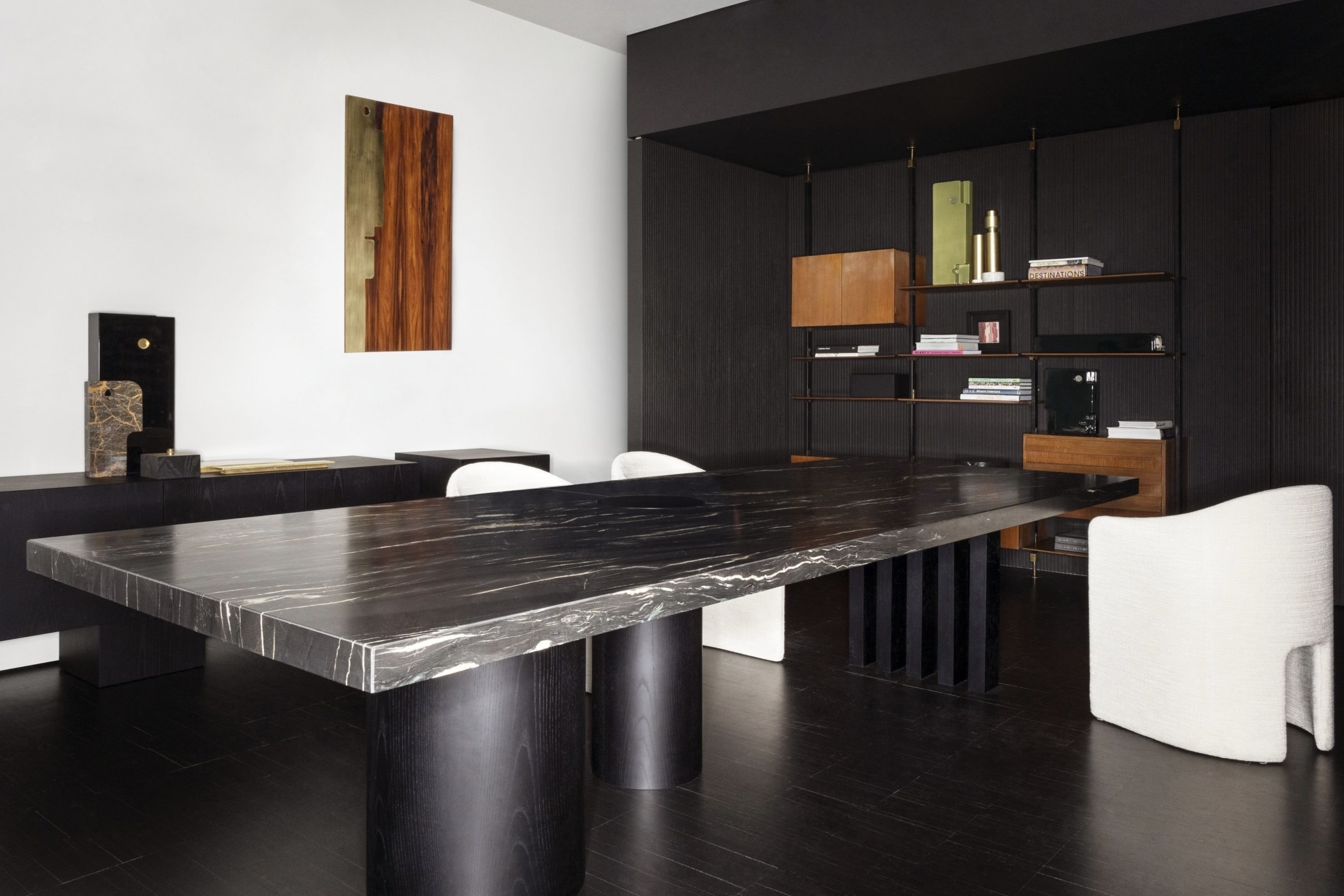
At Boccaccio in Nice, all of this becomes physical. Nicolas hand-painted more than fifty square metres of cotton canvas before the works were mounted onto the walls almost like wallpaper. Painting becomes part of the interior, tied to its proportions, furniture, light and the way people move through the room. Fine art, decoration and interior design stop behaving like separate disciplines.
“That’s exactly the question that has always driven me. I love playing with that contradiction. I keep asking myself how to build bridges between distinct worlds, sometimes far apart.”
“What would a traditional studio painter do if architects came knocking?”
The wall provides its own answer. Light changes, furniture appears in front of the work, people walk past it, the architect has an idea, the client has a budget and the room has a function. A painting acquires neighbours and enters a life the artist can no longer fully control.
Historically, none of this is radical. Fresco belonged to architecture for centuries before we became accustomed to the idea of art as an autonomous object on a white wall under controlled light. Nicolas does not approach that history as theory. If a project requires a new technique, he learns it. He changes material and scale, tests what he can do and allows somebody else’s idea to take him somewhere he might never have reached alone.
That openness was not always the goal. His earlier work moved through stencils, classical imagery and pop references while he searched for a fixed visual world that could be immediately associated with his name.
“Looking back, I was always searching for a defined style. I wanted to build a set visual world, even a repetitive one, so I’d be more easily recognisable.”
“It’s only very recently, especially through this first exhibition, that my style has started to grow out of my real-life experiences. The medium and the end result now come second.”
That is a bigger shift than it might sound. If experience comes first, a painter no longer has to know in advance what “a Nicolas Blažičević” is supposed to look like.
Recognisability is a strange currency in contemporary art. A gallery wants a signature, an audience wants to recognise it, and one successful form can easily create demand for another version, then another, until the artist becomes the most efficient manufacturer of his own signature.
With Nicolas, things are moving in the other direction. Commissions expand his technical repertoire while his personal work becomes more intimate. A stencil, a pop reference or a cotton canvas no longer has to function as an identity to be maintained. The medium can change when what he wants to say changes.
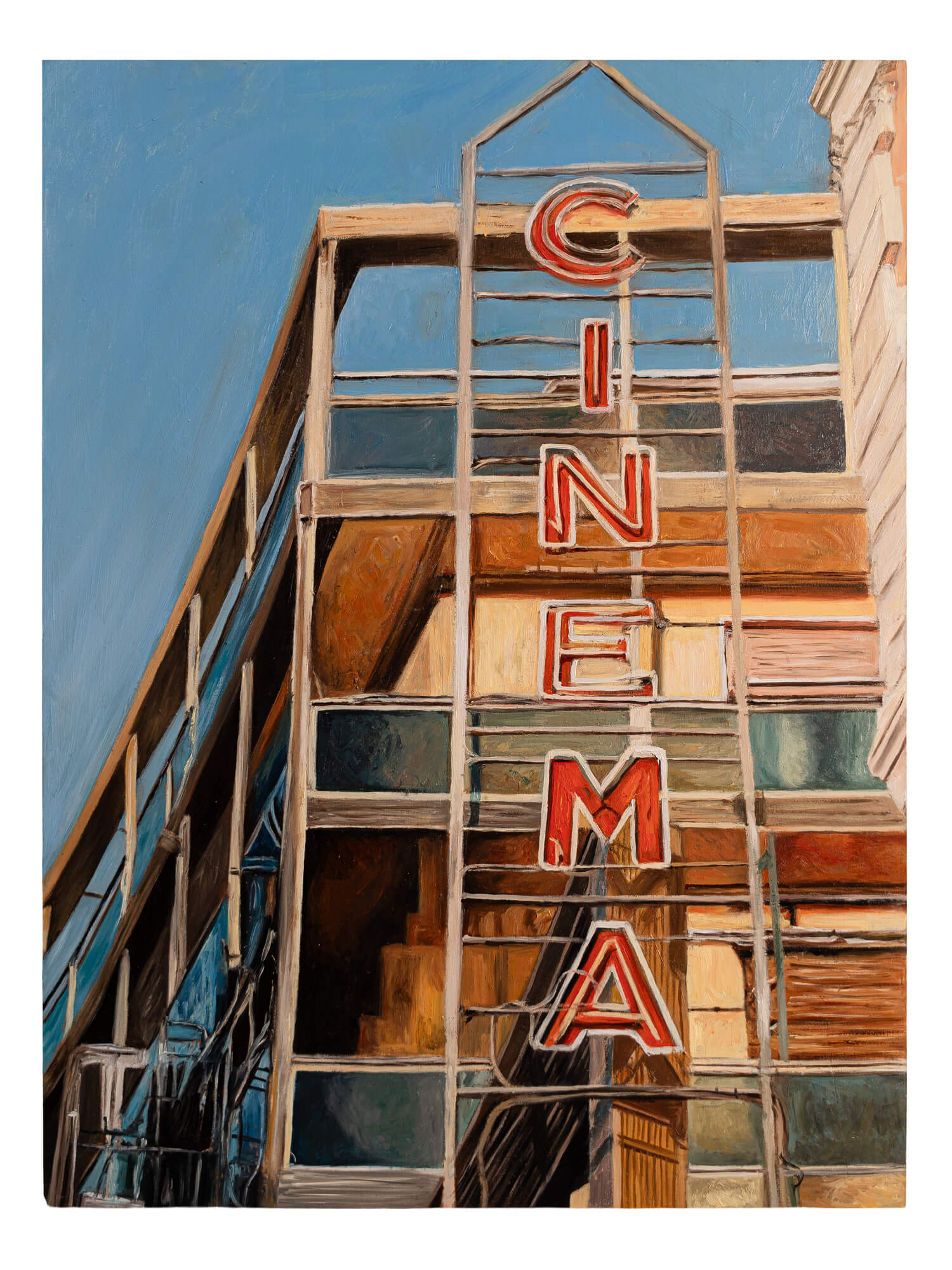
Cinema Paradiso
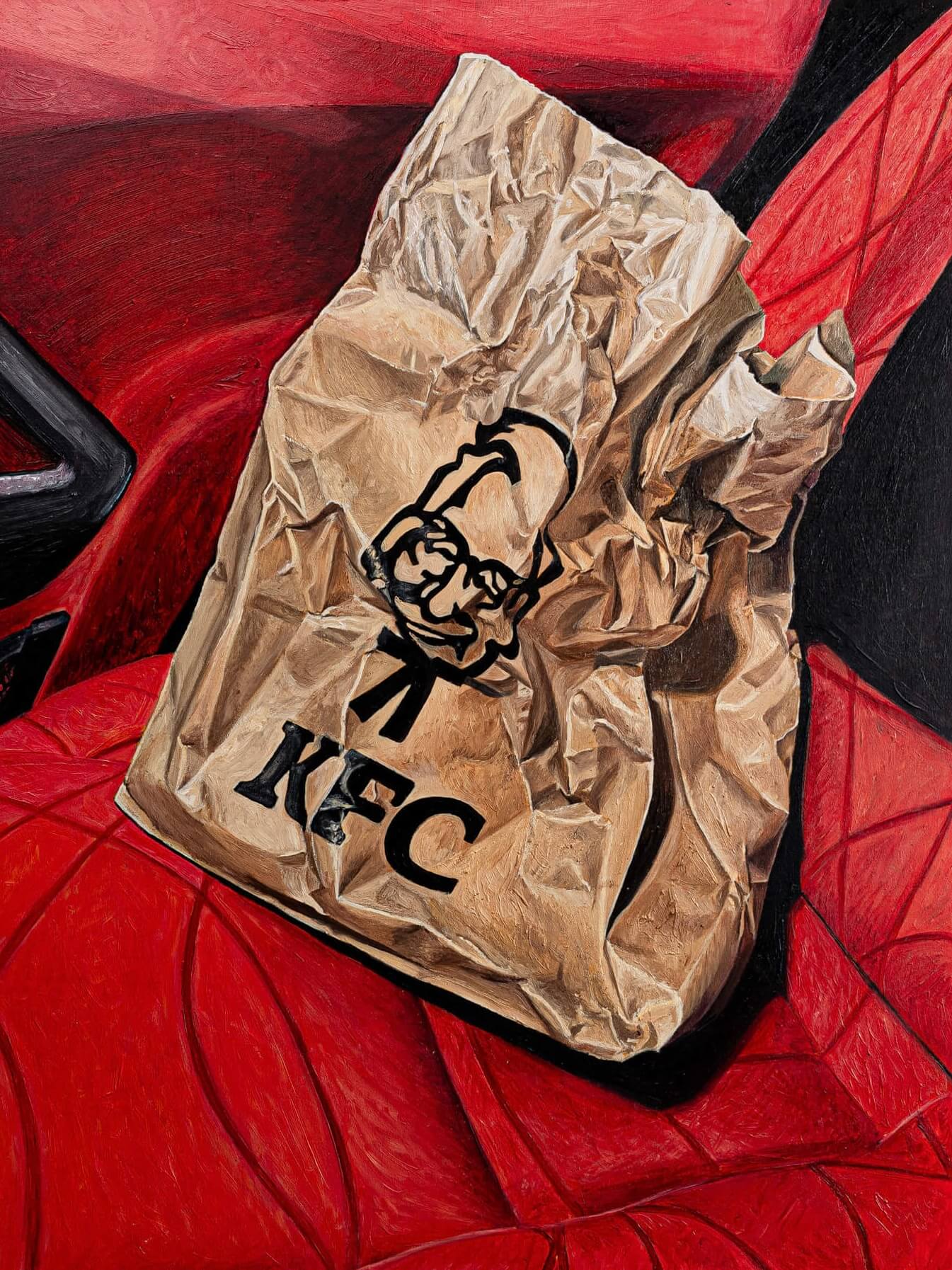
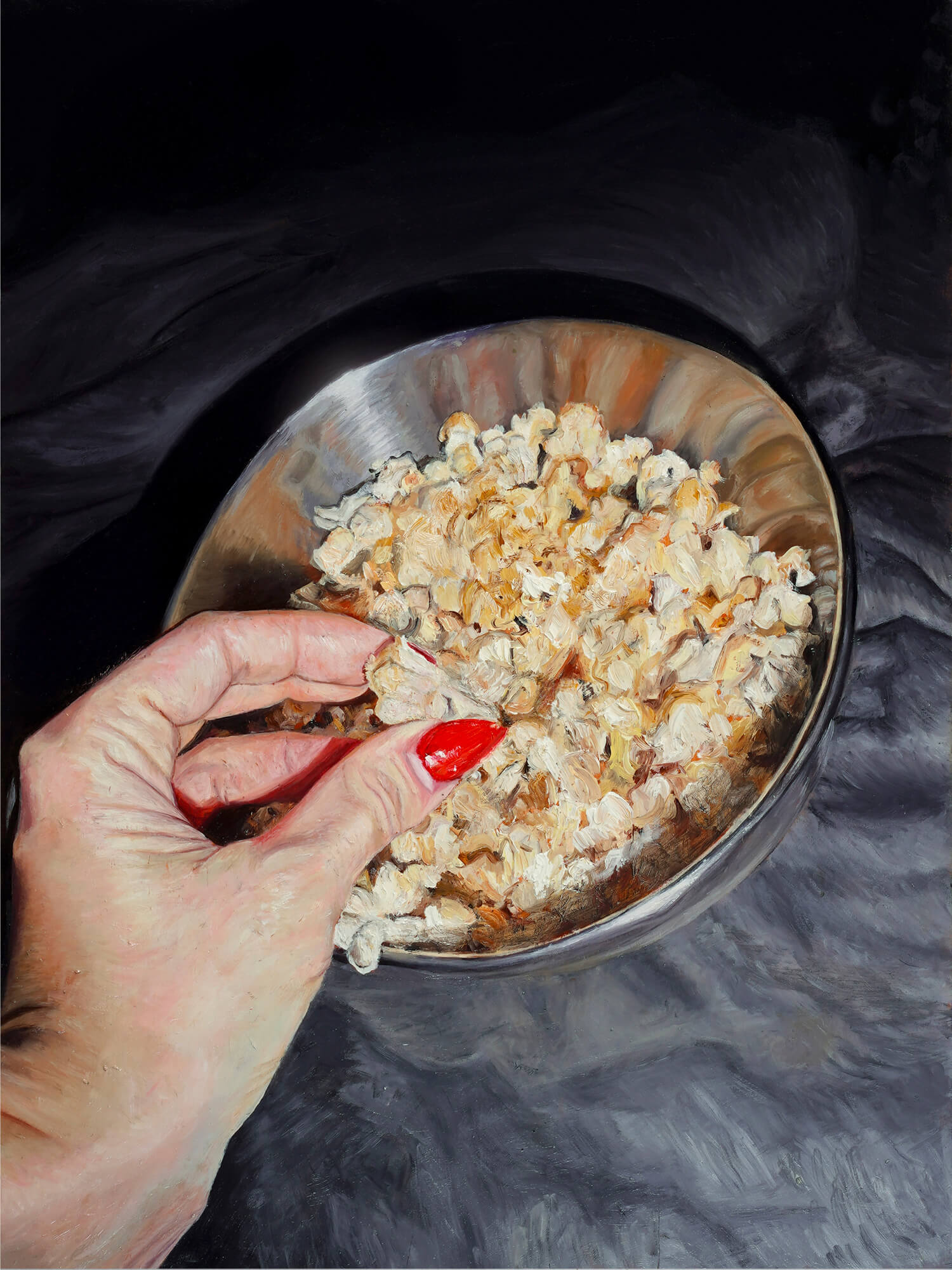
Parking lot Thougts, Enjoy the Show
NICE PEOPLE
Nice comes with considerable visual baggage for a painter. Matisse, Cocteau, Klein, the Mediterranean, hotels, palm trees, sun and that particular blue known equally well by art history and the tourism industry. The city has been painted so many times that growing up there requires a certain resistance to its own scenery.
Nicolas makes no secret of that distance.
“The South has a rich heritage, from today’s talents to those who shaped its culture. But I have to admit I’ve always felt a certain distance from the Riviera’s own symbolism, maybe because my tastes are so eclectic.”
It is not a rebellion against where he comes from. He does not need to escape Nice in order to resist it, nor does he need to paint what Nice is already known for in order to belong to it.
Cities with powerful myths eventually become strange for the people who live in them. What others cross the world to see becomes scenery. Nice has the Riviera. Belgrade has brutalism, kafanas, rivers, nightlife and an entire catalogue of images repeated so often that the city begins to resemble its own souvenir.
Nicolas chooses a kiosk in the rain. There is no representative skyline or heroic architecture. Sheet metal, an advertisement, graffiti, wet asphalt and a small structure nobody intended to represent the city do the job better. Jour de pluie à Belgrade tells me more about the way he looks than any attempt to cast him as an artist caught between “two cultures”. The point is not how much Belgrade there is in him, or how much Nice. It is what he chooses to see in both.
A city also travels through the people it produces, through the way someone works, the worlds they mix, their humour, their relationship with craft and the amount of importance they assign to themselves. The old Belgrade I keep looking for in other cities was never only a collection of streets. It was a type of person: urban enough not to keep proving it, curious enough to cross disciplines and secure enough not to turn everything they do into an identity. I recognise some of that in Nicolas.
When I asked which of his paintings he would never sell, he did not need time to think. None.
“Once a piece is finished, I quickly accept that it no longer belongs to me. It holds sentimental value for me at two moments: while I’m making it, and when I step back to take it in once it’s done. But I let go of it quickly.”
Sometimes quite literally.
“Sometimes I’m not satisfied with a work and simply feel the urge to get rid of it. I either give it to a friend or actually throw it away.”
One of those works was a large-scale painting in shades of pink depicting an intimate part of his then-girlfriend. He had begun it while they were still together, long before the idea of his first exhibition. By the time the exhibition began to take shape, the painting no longer fit what he wanted to make, either in scale or subject.
“So I got rid of it.”
That might have been the end of the story had he not discovered that he is not always the best judge of his own work.
“The most underrated works are often the ones I don’t think are good enough, and those are usually the ones my friends like most.”
Apparently, his friends occasionally have better taste in Nicolas Blažičević than Nicolas Blažičević. So there is a new rule.
“From now on, I’m keeping everything. You never know, I might find myself looking for one of them years later.”
Nice people, then. With people, the method does not work.
“I can’t say the same about my relationships, though, whether with friends or in love.”